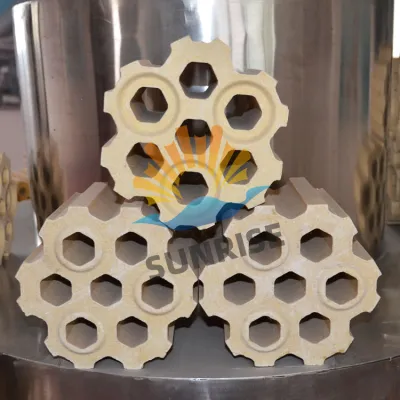
In today’s energy-conscious steel industry, even small inefficiencies in hot blast stoves can lead to significant losses—both financially and environmentally. Many plants still rely on traditional clay or high-alumina bricks, which suffer from poor thermal conductivity and premature cracking under cyclic heating conditions. That’s where silicon brick comes in.
Silicon brick boasts a thermal conductivity of approximately 2.4 W/m·K, nearly 30–40% higher than standard clay brick (~1.7 W/m·K) and over 25% better than high-alumina brick (~1.9 W/m·K). This means faster heat transfer, more consistent temperature profiles, and reduced fuel consumption across the entire furnace cycle.
| Material Type | Thermal Conductivity (W/m·K) | Typical Use Case |
|---|---|---|
| Silicon Brick | ~2.4 | High-efficiency hot blast stoves |
| Clay Brick | ~1.7 | General refractory lining |
| High-Alumina Brick | ~1.9 | Moderate-temperature applications |
But performance isn’t just about material—it’s also about precision. Our silicon bricks are manufactured with strict dimensional tolerances: ±1 mm for hole diameter, ±2 mm for length/width, and flatness within 0.5 mm per meter. These specs ensure tight joints, minimal air leakage, and long-term structural integrity—even after hundreds of heating cycles.
Crack control is another critical factor. We enforce a rigorous inspection protocol: cracks wider than 0.5 mm or longer than 20 mm are rejected outright. Why? Because even micro-cracks can propagate during thermal shock, leading to sudden failure. Proper cooling rates—typically no faster than 50°C/hour—are essential to prevent stress-induced fractures. In fact, one client in South Korea reported a 40% reduction in unplanned downtime after switching to our zero-defect silicon bricks.
For composite brick installations—such as those combining silicon and chrome-magnesia layers—we offer pre-assembly planning tools and on-site technical support. Each brick is individually trimmed to fit, ensuring seamless integration without compromising thermal efficiency.
You may be wondering: “How do I know if my current bricks are failing silently?” If your hot blast stove shows uneven temperature distribution, increased gas usage, or frequent repairs, it might be time to upgrade. Don’t wait until a crack becomes a crisis.
Have you experienced unexpected failures due to cracked bricks? Share your story in the comments below—we’re listening.
Ready to boost efficiency and reduce maintenance costs? Let us help you choose the right silicon brick solution tailored to your plant’s unique needs.
Get Your Free Technical Consultation Today